
For manufacturers, electricity isn't an optional overhead.
Machines need to run. Production lines need to operate. Furnaces, pumps, compressors, refrigeration, extraction and other equipment all need power – regardless of what happens to energy prices.
And when electricity costs rise, manufacturers can't simply switch everything off.
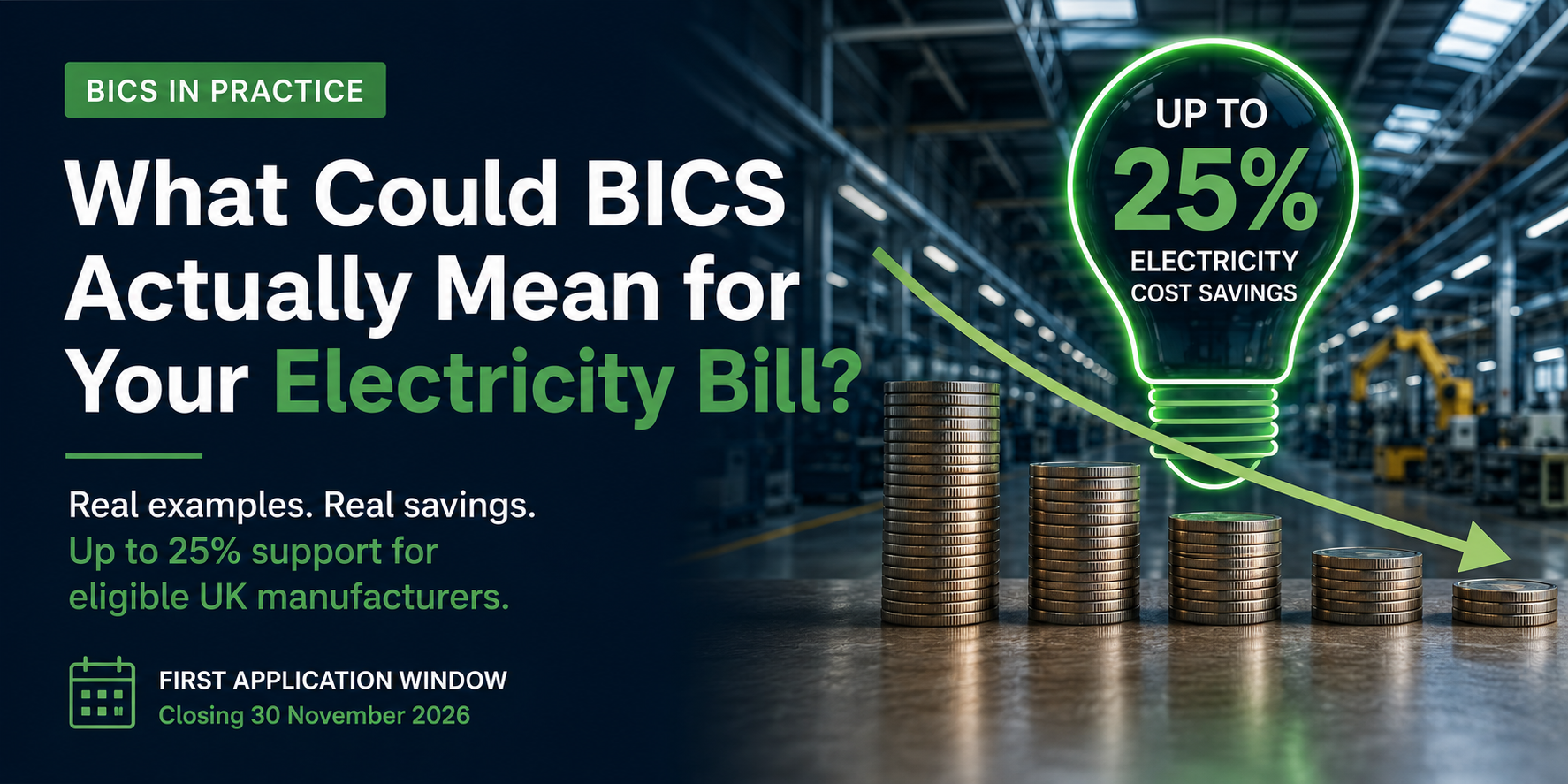
That's why the new British Industrial Competitiveness Scheme (BICS) could be so important.
The Government estimates that eligible businesses could see their electricity bills reduced by up to around 25% through the scheme.
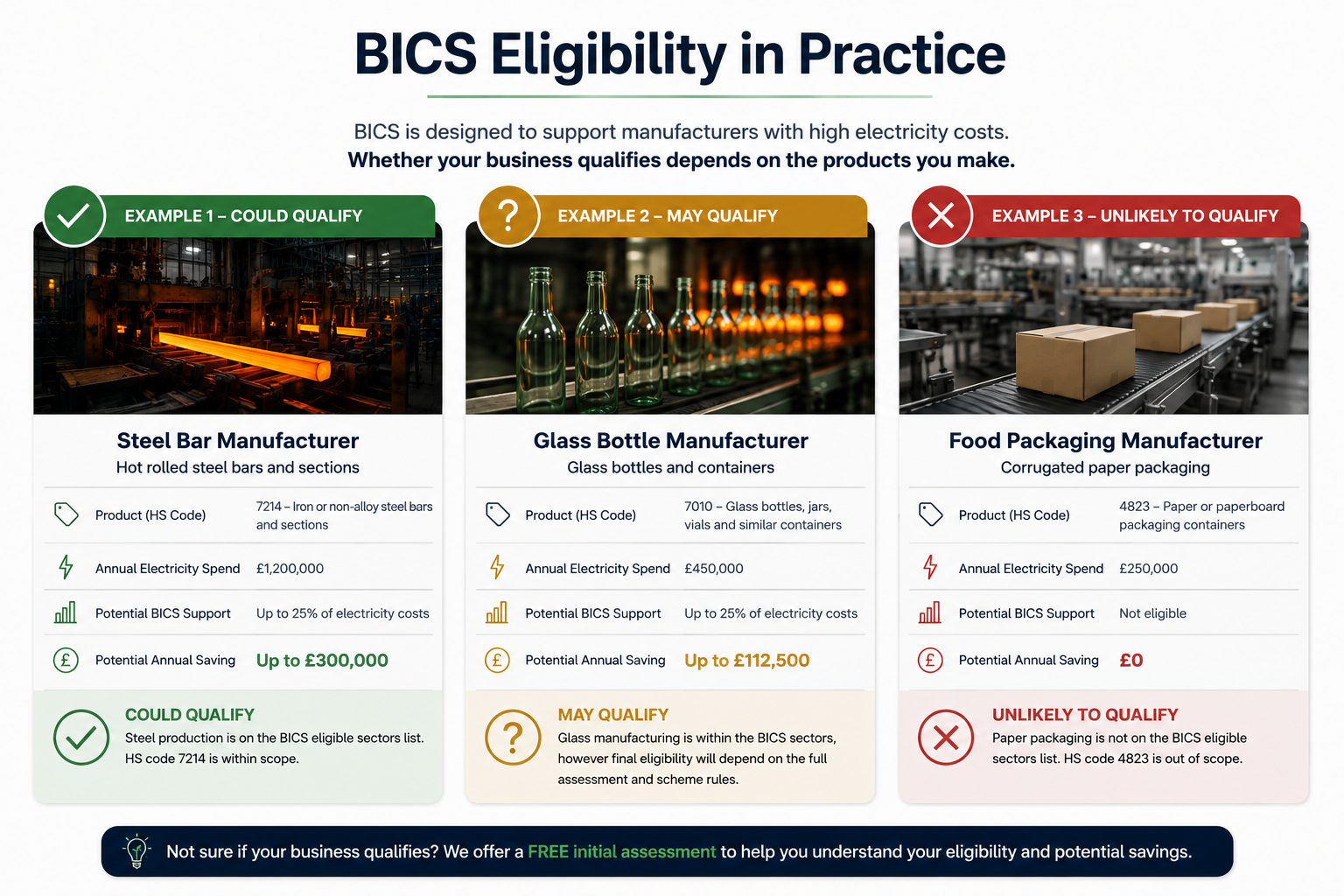
But what could that actually look like in practice?
Let's look at a few examples.
The examples below are illustrative and have been simplified to show the potential scale of BICS support. Actual savings will depend on a business's electricity consumption, tariffs, eligibility and the final operation of the scheme.
And the first year could be particularly interesting
There's another part of BICS that manufacturers should know about.
The ongoing BICS exemptions are due to begin from April 2027.
However, the Government has also announced an additional payment in 2027 relating to the 2026/27 period, intended to recognise the support eligible businesses would have received had BICS already been operating.
In simple terms, some of the value could effectively reach back towards April 2026.
The Government has not yet published all of the detail around how that additional payment will be calculated, so businesses shouldn't assume a particular retrospective payment.
But for successful applicants in the first BICS window, it could make the first year particularly valuable.
The percentage isn't really the point
“Up to 25%” makes a good headline.
But we think the more useful question is:
What could BICS be worth to your business?
For one manufacturer, the answer might be £20,000.
For another, it might be £100,000.
For a larger electricity user, it could potentially be considerably more.
And when manufacturers are already dealing with rising wages, materials, energy, finance and other operating costs, those numbers matter.
This isn't about finding a clever way to use less electricity.
It's about recognising that manufacturers have costs they simply cannot avoid – and reducing some of the policy costs sitting within the electricity they already need to buy.
What would happen in practice?
A manufacturer spending £500,000-a-year……
They hear about BICS and initially aren't sure whether it applies to them.
That's fairly understandable.
Government support schemes aren't always particularly easy to interpret.
So rather than spending hours trying to work through the rules themselves, they ask us to take an initial look.
We establish whether their business appears to fall within the relevant BICS criteria and look at the potential value.
If it isn't a good fit, we'll tell them.
If it is, we can then help them through the application and evidence process.
The aim is that the manufacturer gets the benefit without having to become an expert in BICS themselves.
They can get on with manufacturing.
We'll deal with BICS.
Could your business be one of them?
If you're a UK manufacturer looking at another substantial electricity bill and wondering whether BICS could make a difference, it's worth finding out.
At EII Advisory, we're offering manufacturers a free initial BICS assessment.
We'll look at your business, establish whether we think there's a realistic opportunity and help you understand what the potential saving could look like.
No obligation.
And no need to spend your afternoon reading government guidance.
If there's an opportunity, we'll explain it clearly. If there isn't, we'll tell you that too.
With the first BICS application window closing on 30 November 2026, now is a very good time to understand where your business stands.